The Unfolding Tapestry: How Technology Has Woven Human Civilization

Written by
Ahinsree BPublished
December 31, 2025Reading time
4 min read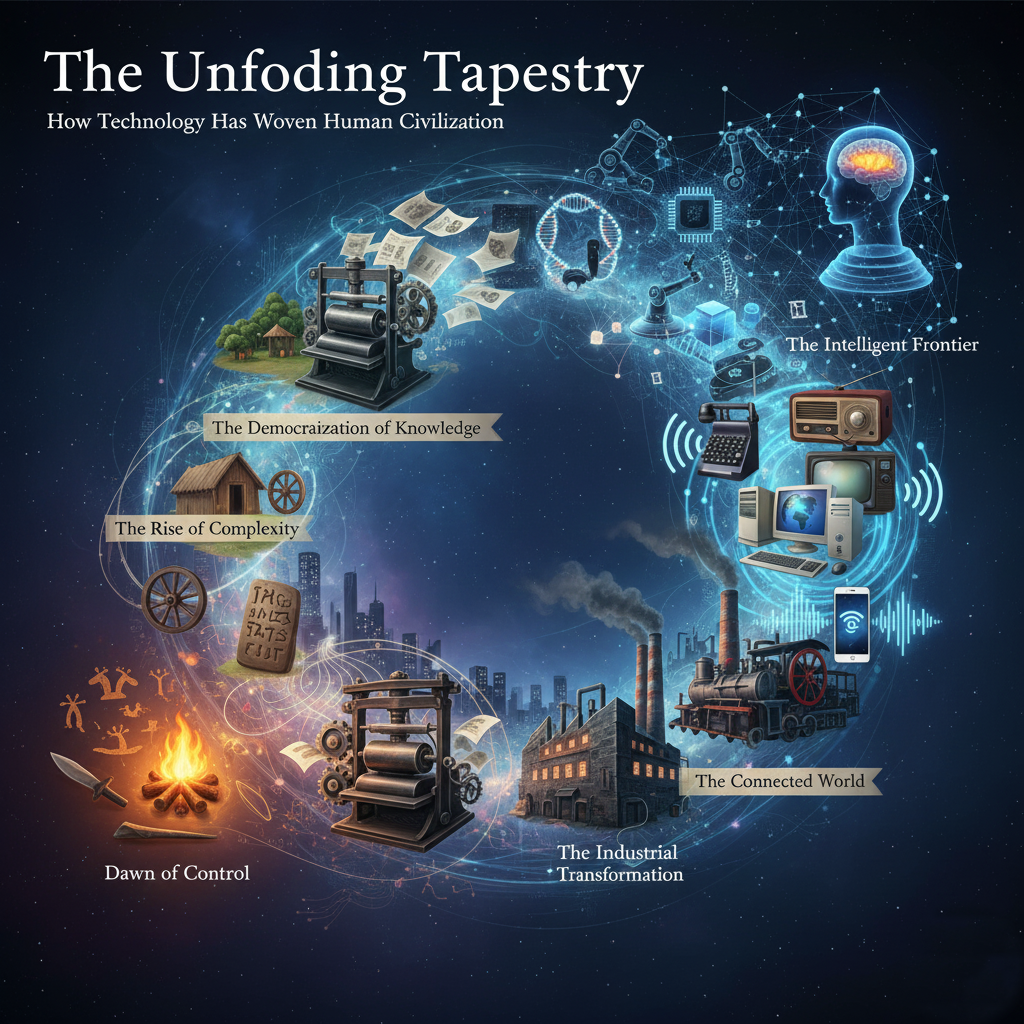
Audio Experience
Listen to this insight in your language
From the first spark of fire to the intricate web of the internet, technology hasn’t just shaped human civilization; it has defined it. Every major leap in our history is inextricably linked to a technological innovation that fundamentally altered how we live, work, connect, and even think. It’s a relationship of constant feedback, where our tools enable new aspirations, and those aspirations, in turn, drive the creation of even more advanced tools.
Let’s explore this profound impact across the ages.
1. The Dawn of Control: Shaping Our Environment
Early technologies were about survival and control. The mastery of fire provided warmth, protection from predators, and allowed us to cook food, leading to better nutrition and brain development. The invention of tools like sharpened stones and spears made hunting more efficient, while the development of agriculture transformed nomadic hunter-gatherers into settled communities.
- Impact: This shift created the first permanent settlements, leading to the concept of property, surplus food, and eventually, the specialization of labor and the birth of villages and towns.
2. The Rise of Complexity: Building Societies
As communities grew, so did the need for organization and communication. The wheel revolutionized transportation and trade, making it possible to move goods and people over vast distances. Writing systems emerged, allowing knowledge, laws, and stories to be recorded and passed down through generations, rather than relying solely on oral tradition.
- Impact: Writing systems were foundational for the development of complex legal systems, bureaucratic administrations, and the spread of ideas that underpinned empires and early philosophies. It enabled the coordination of large-scale projects, from pyramids to aqueducts.
3. The Democratization of Knowledge: Igniting Revolutions
For centuries, knowledge was confined to scribes and elites. The invention of the printing press in the 15th century shattered this barrier. Suddenly, books could be mass-produced, making information accessible to a wider population than ever before.
- Impact: The printing press fueled the Renaissance, the Reformation, and the Scientific Revolution. It democratized literacy, challenged established authorities, and laid the groundwork for modern education and public discourse. It was, arguably, the first true “information revolution.”
4. The Industrial Transformation: Reshaping Labor and Lifestyle
The 18th and 19th centuries witnessed the Industrial Revolution, powered by inventions like the steam engine and factory machinery. This wasn’t just about new tools; it was about a new way of life. Production moved from homes to factories, creating unprecedented amounts of goods but also leading to urbanization, new social classes, and shifts in work-life balance.
- Impact: This era created the modern city, altered family structures, and gave rise to new economic theories and political movements. It dramatically increased productivity and consumer goods but also introduced challenges like pollution and labor exploitation.
5. The Connected World: Bridging Distances and Cultures
The 20th and 21st centuries brought an explosion of communication technologies. The telegraph, telephone, radio, and television progressively shrank the world, allowing real-time communication and mass media to shape public opinion and disseminate culture globally. The advent of the computer and, critically, the Internet, then transformed information sharing into an interactive, ubiquitous experience.
- Impact: The internet has created a global village, fostered unprecedented levels of interconnectedness, and revolutionized commerce, education, and social interaction. It has given rise to new industries, blurred geographical boundaries, and presented both incredible opportunities for collaboration and challenges like misinformation and digital divides.
6. The Intelligent Frontier: Augmenting Humanity
Today, we stand at the precipice of another monumental shift with Artificial Intelligence, biotechnology, and advanced robotics. These technologies promise to automate complex tasks, enhance human capabilities, and solve some of the world’s most pressing problems, from climate change to disease.
- Impact: While still unfolding, these technologies are set to redefine work, creativity, and even our understanding of intelligence. They present questions about ethics, control, and the very future of human agency, offering the potential for unparalleled progress alongside profound societal shifts.
Conclusion: A Never-Ending Dialogue
Technology is not a neutral force; it’s a dynamic partner in our evolution. It reflects our ingenuity, solves our problems, and often creates new ones, pushing us to adapt and grow. From the first spark of innovation to the complex algorithms of today, technology continues to weave the intricate tapestry of human civilization, constantly changing its patterns and promising new horizons.
About Ahinsree B
Building systems for wealth, career, and communications. Dedicated to helping professionals architect a life of freedom and influence.
Inside the Issue
35% through